
布达佩斯
Patient with both legs severed at thigh level walks again after doctors perform rare replantation surgery in East China’s Jiangsu_我的网站

A |
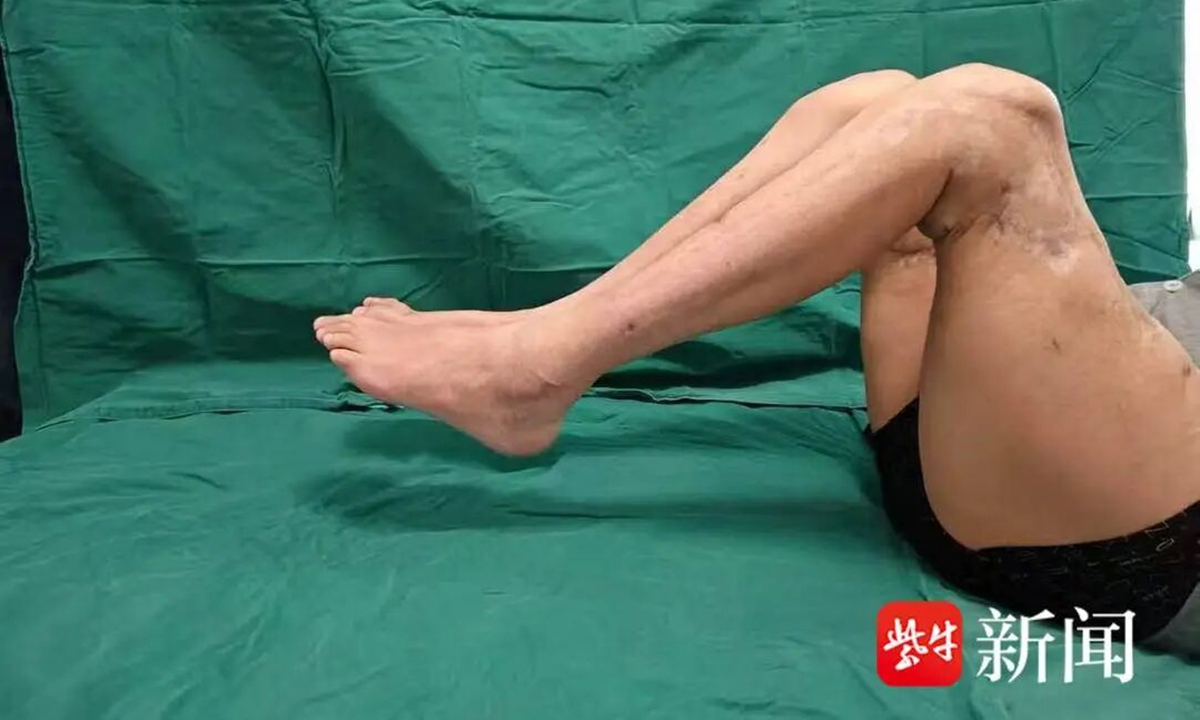
The patient, a 51-year-old surnamed Jiang, had both legs completely severed at the thighs in a machinery accident at a factory on December 2, 2024. A multidisciplinary team from the trauma orthopedics and joint surgery departments at Suzhou Ruihua Orthopedic Hospital, in East China's Jiangsu Province, worked through the night for nearly eight hours to reattach the two limbs, the report said.
Li Changsong, head of a trauma orthopedics team at the hospital, told the Yangtze Evening Post on Tuesday that Jiang can now walk indoors with a walker and manage most daily activities without assistance. Sensation in his lower limbs has also recovered to the area above his ankles.
"He is still recovering and is expected to gradually stop using crutches and eventually walk independently," Li was quoted as saying by the Yangtze Evening Post on Wednesday.
In March last year, shortly after the external fixators were removed from both legs, Jiang could already lift his legs freely while lying in bed. Sensation had returned as far down as the middle of his lower legs, and he was discharged from the hospital on March 5. His main goal at the time was to stand and walk again through rehabilitation, according to the report.
More than a year later, Jiang has moved from being confined to bed to lifting his legs and then standing and walking, the report said, noting that his rehabilitation is still ongoing.
The recovery process has not been without complications. Jiang developed localized skin necrosis after the operation and underwent flap reconstruction surgeries. He later required bone grafting and reinforced internal fixation of both femurs after severe open comminuted fractures resulted in femoral nonunion.
Li said Jiang is now in good overall condition, with his legs approximately equal in length.
"A novelty assessment conducted by the Jiangsu Institute of Medical Information confirmed this as the world's first case of replantation following the complete severing of both thighs," Li said.
Li said the case was considered a world first primarily because both legs were completely severed at thigh level simultaneously, an extremely rare injury. The hospital had previously accumulated extensive experience in replanting single limbs and lower legs, while its expertise in fracture fixation, vascular anastomosis and nerve repair provided an important technical foundation for the operation, according to the report.
Li did not give a timetable for when Jiang might be able to stop using a walker completely.
"Recovery varies from person to person. We still need to monitor his muscle strength, nerve sensation and fracture healing," Li said. Based on his current progress, however, Jiang's walking ability could continue to improve, the Yangtze Evening Post reported.
Global Times
。
Labor Day is a U.S. national holiday held the first Monday every September. Unlike most U.S. holidays, it is a strange celebration without rituals, except for shopping and barbecuing. For most people it simply marks the last weekend of summer and the start of the school year.
The holiday’s founders in the late 1800s envisioned something very different from what the day has become. The founders were looking for two things: a means of unifying union workers and a reduction in work time.
The first Labor Day occurred in 1882 in New York City under the direction of that city’s Central Labor Union.
In the 1800s, unions covered only a small fraction of workers and were balkanized and relatively weak. The goal of organizations like the Central Labor Union and more modern-day counterparts like the AFL-CIO was to bring many small unions together to achieve a critical mass and power. The organizers of the first Labor Day were interested in creating an event that brought different types of workers together to meet each other and recognize their common interests.
However, the organizers had a large problem: No government or company recognized the first Monday in September as a day off work. The issue was solved temporarily by declaring a one-day strike in the city. All striking workers were expected to march in a parade and then eat and drink at a giant picnic afterwards.
Why was Labor Day invented?
Labor Day came about because workers felt they were spending too many hours and days on the job.
In the 1830s, manufacturing workers were putting in 70-hour weeks on average. Sixty years later, in 1890, hours of work had dropped, although the average manufacturing worker still toiled in a factory 60 hours a week.
These long working hours caused many union organizers to focus on winning a shorter eight-hour work day. They also focused on getting workers more days off, such as the Labor Day holiday, and reducing the workweek to just six days.
These early organizers clearly won since the most recent data show that the average person working in manufacturing is employed for a bit over 40 hours a week and most people work only five days a week.
As the U.S. economy expanded beyond farming and basic manufacturing in the late 1800s and early 1900s, it became important for businesses to find consumers interested in buying the products and services being produced in ever greater amounts. Shortening the work week was one way of turning the working class into the consuming class.
The common misconception is that since Labor Day is a national holiday, everyone gets the day off. Nothing could be further from the truth.
While the first Labor Day was created by striking, the idea of a special holiday for workers was easy for politicians to support. It was easy because proclaiming a holiday, like Mother’s Day, costs legislators nothing and benefits them by currying favor with voters. In 1887, Oregon, Colorado, Massachusetts, New York and New Jersey all declared a special legal holiday in September to celebrate workers.
Within 12 years, half the states in the country recognized Labor Day as a holiday. It became a national holiday in June 1894 when President Grover Cleveland signed the Labor Day bill into law. While most people interpreted this as recognizing the day as a national vacation, Congress’ proclamation covers only federal employees. It is up to each state to declare its own legal holidays.
Moreover, proclaiming any day an official holiday means little, as an official holiday does not require private employers and even some government agencies to give their workers the day off. Many stores are open on Labor Day. Essential government services in protection and transportation continue to function, and even less essential programs like national parks are open. Because not everyone is given time off on Labor Day, union workers as recently as the 1930s were being urged to stage one-day strikes if their employer refused to give them the day off.
In the president’s annual Labor Day declaration last year, Obama encouraged Americans “to observe this day with appropriate programs, ceremonies and activities that honor the contributions and resilience of working Americans.”
The proclamation, however, does not officially declare that anyone gets time off.
Controversy: Militants and founders
Today most people in the U.S. think of Labor Day as a noncontroversial holiday.
The first controversy that people fought over was how militant workers should act on a day designed to honor workers. Communist, Marxist and socialist members of the trade union movement supported May 1 as an international day of demonstrations, street protests and even violence, which continues even today.
More moderate trade union members, however, advocated for a September Labor Day of parades and picnics. In the U.S., picnics, instead of street protests, won the day.
There is also dispute over who suggested the idea. The earliest history from the mid-1930s credits Peter J. McGuire, who founded the New York City Brotherhood of Carpenters and Joiners, in 1881 with suggesting a date that would fall “nearly midway between the Fourth of July and Thanksgiving” that “would publicly show the strength and esprit de corps of the trade and labor organizations.”
Later scholarship from the early 1970s makes an excellent case that Matthew Maguire, a representative from the Machinists Union, actually was the founder of Labor Day. However, because Matthew Maguire was seen as too radical, the more moderate Peter McGuire was given the credit.
Who actually came up with the idea will likely never be known, but you can vote online here to express your view.
Have we lost the spirit of Labor Day?
Today Labor Day is no longer about trade unionists marching down the street with banners and their tools of trade. Instead, it is a confused holiday with no associated rituals.
The original holiday was meant to handle a problem of long working hours and no time off. Although the battle over these issues would seem to have been won long ago, this issue is starting to come back with a vengeance, not for manufacturing workers but for highly skilled white-collar workers, many of whom are constantly connected to work.
If you work all the time and never really take a vacation, start a new ritual that honors the original spirit of Labor Day. Give yourself the day off. Don’t go in to work. Shut off your phone, computer and other electronic devices connecting you to your daily grind. Then go to a barbecue, like the original participants did over a century ago, and celebrate having at least one day off from work during the year!
。Current article:http://bdte82.zhaoliebengkuaiwaigeqi.bond/lox/20260826/4173.html
Published on:14:34:29
我的网站最近更新
- 【假期提醒】喜迎元旦 辞旧迎新–郑州市郑东新区实验幼儿园元旦假期温馨提示
- 中国语言资源保护工程成果展示馆开馆
- Nothing Ear(3a)图赏:透明工业风,极具表现力
- सिंह से वृश्चिक Aaj Ka Rashifal 29 अगस्त 2025: कन्या वालों के लिए बन रहे हैं लाभ के योग, पढ़ें राशिफल
- 2025京东618最新红包口令:红包588,淘宝618红包口令:好运红包8811
- This Is What Suniel Shetty Told Ahan Shetty About His Role in Border 2
- 7月我国完成营业性货运量49亿吨
- Xbox 与 PlayStation 似乎正公开淡化对多平台游戏发布的宣传宣传力度
- B费当选PFA赛季最佳球员,曼联官方社媒晒海报庆祝:实至名归
- 2026年浙江福彩“走进福彩公益金资助项目” 首站活动在衢州举行
- Kiara Advani drops a hint at the next chapter in a new post
- Zhuque-3 chief commander reveals cause of Y1 rocket's failed recovery, saying its data contributed to Y2's success
- 水利部专题部署太湖流域洪水防御工作
- 这个乡镇“筹资”有方,奖励一位90后教师价值200万元住房_尤凡_教育
- 众志成城,国足逼平日本队
- 兴城安排部署复工复产安全防范工作
- 一觉醒来,国乒男队惨败丢冠
- 国际素食日 | 今天,你吃素了吗?
- 2025国补和618活动哪个更便宜?国家补贴什么时候结束?可以叠加使用吗
- 【联结家庭】冬日暖阳,亲子相伴——记杭州市文澜幼儿园社区亲子活动
- 内蒙古乌海地区焦炭价格快报
- [단독] 이 대통령, 공직 경력 특례 폐지 이행 지시
- 两部门对福建启动防汛防台风四级应急响应
- 曼晚:曼联持续关注布鲁日前锋特雷索尔迪,已知需要大约4300万镑
我的网站热门资讯
- 记者:预计佩林转会巴勒莫今日官宣,合同期至2029年
- Video - Larry the Cat Refuses to Enter 10 Downing Street During Press Conference
- 阿努诺比:看好NBA欧洲新联赛 尼克斯要冲击卫冕
- 杭州地铁9号线二期站名正式公布,7大站点抢先看!
- “Token大厂”硅基流动三年亏4亿冲IPO,阿里华为美团都投了
- 荣耀机器人闪电1500米跑出2分30秒22,打破人类世界纪录,本届赛事已三破纪录
- 美债救市升级?特朗普放狠话:必要时动用军队
- 1-6月我国纱线面料出口426.8亿美元,同比增长2.8%
- 官方:切尔西后卫迪萨西租借加盟水晶宫,租期涵盖2026/27赛季
- (经济观察)海南商业航天加速起势 中外企业纷落子,(经济观察)海南商业航天加速起势 中外企业纷落子
- 应急管理部调派13支排涝队伍赴周口开展排涝作业
- 又是一年好“丰”景 绘就乡村振兴图
- 中医支招长夏补水:少量多次饮用温水为宜
- 冲冠拼图!曝骑士希望先签后换沃特森:筹划交易施罗德+斯特鲁斯
- 突破百万美元众筹,LUMISTAR CARRY篮球发球机重新定义“AI队友”
- 研究:蝙蝠身上发现的病毒与埃博拉病毒有关。
- 海南产经新观察:商业航天加速起势,海南产经新观察:商业航天加速起势
- 美国站群服务器搭建sk5需要什么配置?
- 一名男子遭恶性袭击,被抛下码头并按在水下,警方急寻目击者
- 领克回应主动召回领克900等车型:免费更换激光雷达
- 荧屏述初心 福彩绽芳华 泰州泰兴两名福彩站主亮相全国福彩直播
- 神龙汽车吕海涛:变局中开新局 跑出自主合资加速度
- 奋进强国路 阔步新征程丨智能制造引领“老字号”企业迈向高质量发展
- 不调休!2025年新加坡公共假期公布,探校预约注意哦